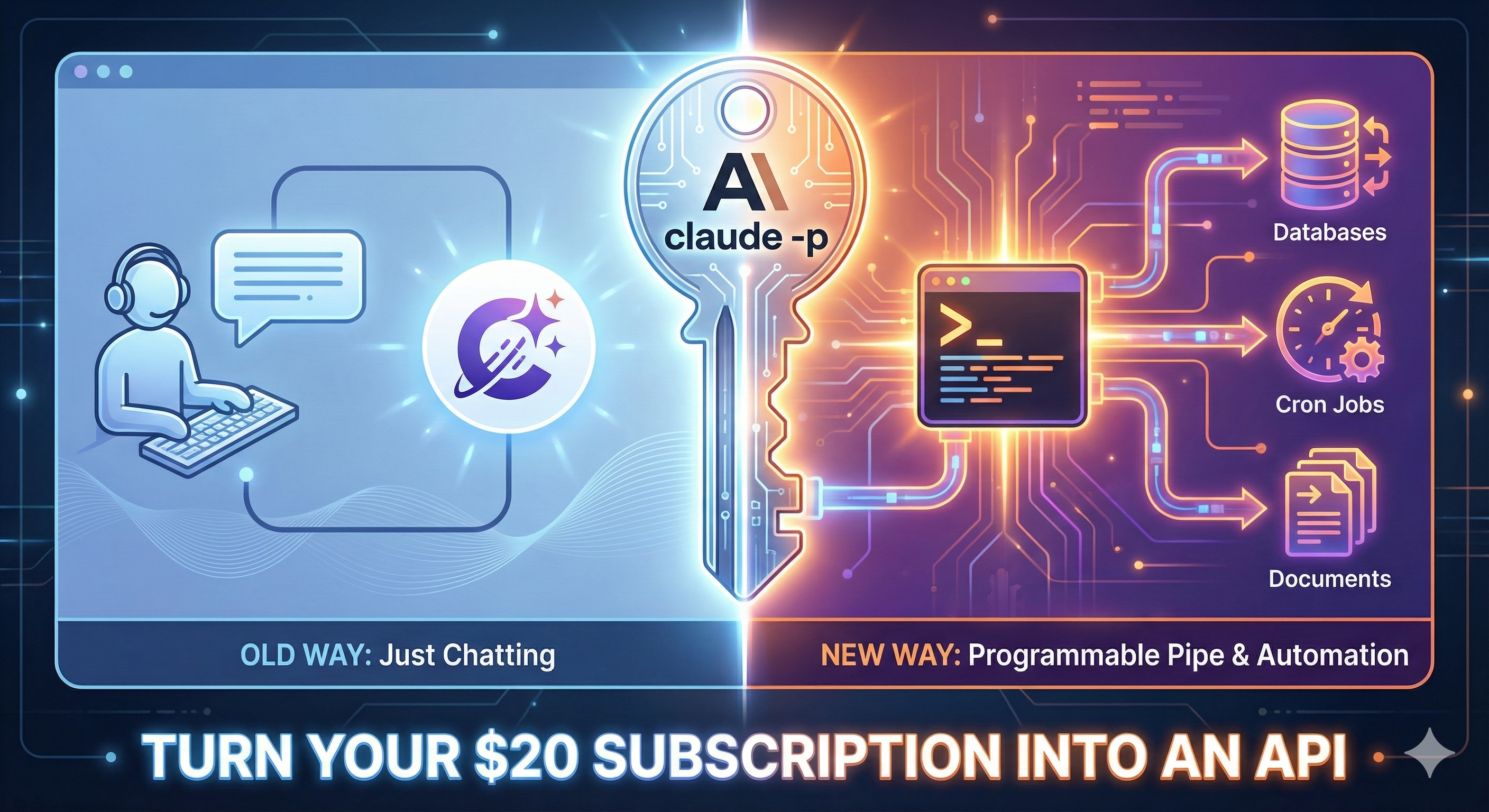
The $20 AI You're Not Using
How a 3-Hour Side Project Revealed a Hidden Interface to Claude
Last week, I built a tool called Noca (NoteCapture, lol) [https://github.com/waynewangyuxuan/Noca.git]. The idea was simple: I wanted to capture scattered information throughout the day—links, ideas, notes—without stopping to organize them. At the end of the day, AI would sort everything into my Notion inbox.
Three hours later, it worked. A Raycast hotkey to capture. A local JSON file to store. A shell script to process. Done.
But the interesting part wasn't the tool itself. It was the moment I wrote this line:
cat ~/captures/today.json | claude -p "Organize this into markdown."
I stared at it for a minute. This was calling Claude Code's print mode—a non-interactive flag that takes input, returns output, and exits. Like grep or sed, but with a language model behind it.
And it was using my existing $20 subscription. Not API credits. Not a new billing account. Just the Claude Pro I was already paying for.
That's when I realized: I'd been thinking about this tool wrong. Most people have too.
The Economics Nobody Talks About
Here's what Anthropic doesn't advertise: Claude Code's -p flag turns your subscription into a programmable interface.
The math works like this. A Claude Pro subscription costs 150 in API credits. Anthropic's own data shows the average Claude Code user spends about 12/day.
If you're a subscriber who only uses the chat interface, you're leaving money on the table.
The -p flag changes everything. Pipe data in, get structured output back. Chain it with other commands. Run it in cron jobs. Build it into your own tools. All on the quota you've already paid for.
# This costs you nothing extra if you have Pro/Max
cat error.log | claude -p "Find the root cause"
git log --oneline -20 | claude -p "Write release notes"
curl -s "https://news.ycombinator.com/rss" | claude -p "Summarize top stories"
The API is pay-per-token. The subscription is flat-rate. Most people who want automation default to the API. They're paying twice.
A Tool Named "Code" That Isn't Just for Coding
Claude Code has a branding problem.
The name makes non-technical people run the other way. Even developers assume it's only for writing software. But look at what Anthropic shipped in late 2024 and 2025: browser automation, Slack integration, mobile delegation, organizational workflows. These aren't coding features. They're general-purpose automation primitives.
Shrivu Shankar, a developer who wrote one of the most detailed breakdowns of Claude Code, put it bluntly on his Substack:
"Claude Code isn't just an interactive CLI; it's also a powerful SDK for building entirely new agents—for both coding and non-coding tasks. I've started using it as my default agent framework over tools like LangChain/CrewAI for most new hobby projects."
He's using it to build internal chat tools for non-technical users. To trigger PRs from Slack and Jira. To batch-process files with parallel claude -p calls.
But he's an outlier. When Anthropic opened Issue #762 on GitHub asking "What are you using print mode for?"—specifically to collect use cases—the responses were sparse. Most focused on CI/CD pipelines and code review. Almost nobody mentioned personal automation.
The pattern exists. The awareness doesn't.
What Noca Taught Me
Building QuickCapture took three hours. Most of that was figuring out the Raycast extension API. The AI part was trivial:
cat $CAPTURE_FILE | claude -p "
You are organizing my daily captures.
Group links together. Group ideas together.
Mark anything with 'deadline' or '要' as TODO.
Output clean markdown.
" > $OUTPUT_FILE
The script runs at midnight. By morning, my Notion inbox has a sorted summary of everything I captured the day before.
No server. No API key management. No billing surprises. Just a shell script calling a CLI tool that's included in my subscription.
This is what made me curious: why isn't everyone doing this?
The answer, I think, is that nobody's connected the dots. The subscription users are chatting. The automation users are paying for API. There's no bridge between these populations.
Consider what's possible with just claude -p:
Personal Knowledge Management
# Daily journal → weekly summary
cat ~/journal/week-*.md | claude -p "Summarize themes and insights"

# Research notes → structured outline
cat ~/research/*.txt | claude -p "Create an annotated bibliography"

# Browser bookmarks → organized categories
cat bookmarks.html | claude -p "Categorize and deduplicate"
Content Workflows
# Meeting transcript → action items
cat transcript.txt | claude -p "Extract action items with owners and deadlines"

# Rough draft → polished copy
cat draft.md | claude -p "Edit for clarity. Keep my voice."

# Multiple sources → synthesis
cat source1.txt source2.txt source3.txt | claude -p "Compare and contrast"
Life Admin
# Email inbox → priority sort
cat emails.json | claude -p "Rank by urgency. Summarize each."

# Bank statements → spending analysis
cat statements/*.csv | claude -p "Categorize spending. Find anomalies."

# Recipe collection → meal plan
cat recipes/*.md | claude -p "Create a week's meal plan. Generate shopping list."
Each of these would traditionally require either manual effort, custom code, or paid API calls. With -p mode, they're one-liners that run on your existing subscription.
The Missing Ecosystem
When I researched this pattern, I expected to find a thriving ecosystem of personal automation tools built on Claude Code. I didn't.
What exists:
- ccusage: A tool to track how much of your subscription you're using (useful, but meta)
- awesome-claude-code: A curated list of resources (almost entirely coding-focused)
- claude-code-action: GitHub automation (developer workflows)
What doesn't exist:
- A "Zapier for Claude Code" that lets non-developers chain
pcalls - Template libraries for common personal automation tasks
- GUI wrappers that hide the command line from normal users
The closest thing I found was a Medium post by someone named Melvin Vivas, who built a news research agent using the Claude Agent SDK. He used it to find AI news and translate it to Korean. It worked. But it required programming knowledge and API familiarity—exactly the barriers that subscription users don't have.
This is an opportunity gap. Claude Code has the primitives for general-purpose automation. Nobody's built the bridges yet.
Why This Matters Beyond Productivity
There's a larger story here about how AI capabilities get distributed.
Right now, there are two ways to programmatically access Claude:
- The API (pay-per-use, requires developer knowledge)
- Claude Code's
pflag (subscription-included, requires command line familiarity)
The first is well-documented, well-tooled, and expensive at scale. The second is barely discussed, has almost no ecosystem, and is essentially free for existing subscribers.
This creates an interesting dynamic. The people who most need AI automation—busy professionals, small business owners, students—are least likely to know about the subscription-based path. They either use the chat interface (limited) or give up on automation entirely (expensive/complex).
Meanwhile, developers who could easily use -p mode often default to the API anyway, because that's what the documentation emphasizes and what third-party tools support.
The result: a powerful interface sits underutilized.
A Sketch of What Could Exist
Imagine a world where Claude Code's non-coding potential was fully realized:
Personal Automation Recipes
A community library of tested claude -p commands for common tasks. Not code repositories—just copy-paste shell commands with explanations. "Here's how to summarize your Kindle highlights." "Here's how to generate weekly reports from your time tracker."
Subscription-Aware Tooling
Apps that detect whether you have a Claude subscription and route through -p mode by default, falling back to API only when necessary. Your subscription becomes a universal AI backend.
Scheduled Personal Agents A simple GUI where you define: "Every Sunday at 8am, run this prompt against this folder." No code. No cron syntax. Just plain English instructions and file paths.
Pipe-able Data Formats
Converters that take common formats (emails, calendar events, browser history, health data) and output them in Claude-friendly text. The plumbing that makes -p useful for non-developers.
None of this exists yet. But the foundation is there.
How to Start
If you have a Claude Pro or Max subscription and want to experiment:
1. Install Claude Code
npm install -g @anthropic-ai/claude-code
2. Authenticate
claude logi
3. Try a simple pipe
echo "Hello, this is a test" | claude -p "Translate to Japanese"
4. Build something small
Pick one repetitive task in your life. Something you do weekly that involves text processing. Write a shell script that pipes the relevant data through claude -p. See if it works.
The learning curve is real but small. If you can use Terminal at all, you can do this.
What I'm Building Next
Noca was a proof of concept. It showed me that the constraint isn't technical capability—it's imagination and awareness.
I'm now thinking about what else fits this pattern: personal tools that use subscription-based Claude as their AI backend. Things that don't justify API costs but would benefit from language model processing.
Some candidates:
- A reading list manager that summarizes articles as I save them
- A voice memo transcriber that also extracts action items
- A personal CRM that writes follow-up email drafts
- A receipt scanner that categorizes expenses and flags anomalies
Each of these could be a weekend project. Each would run on the subscription I already pay for.
The larger question is whether this pattern scales beyond individual hobbyists. Can tools built on subscription-tier Claude Code serve teams? Businesses? Or does the quota system make that impractical?
I don't know yet. But I'm going to find out.
The Punchline
You're probably paying $20-200/month for Claude access. You're probably using it to chat.
There's a command-line flag that turns that subscription into a programmable AI interface. It works with pipes. It works with scripts. It works with cron jobs.
Almost nobody's talking about it. Almost nobody's building on it.
The tool is called Claude Code. The flag is -p. The opportunity is yours.
If you build something with this pattern, I want to hear about it. The ecosystem is empty and waiting.